Field note 01
11 Cookout Games People Will Actually Play
September 4, 2026 · The useful version
Good cookout games should survive the cookout. The rules need to be short enough to explain while someone is holding a paper plate. People should be able to join, leave and come back without filing paperwork. Mixed ages and skill levels should still have a chance, and setup should not consume the part of the afternoon when everyone is actually awake.
The right game depends on your space, guest count and willingness to transport large pieces of lumber. A patio needs a different answer than a park. An active group may want roundnet. People mostly eating and talking need something slower, with easy rotation. These 11 outdoor cookout games all work for a reason. They also have limitations. Here are both.
The fast answer
Compare before people arrive.
| Game | Best For | Players | Setup | Space | Easy to Pack? |
|---|---|---|---|---|---|
| Cornhole | Easy rotation | 2–4 | 1–2 min | Large | Not really |
| Bocce | Relaxed groups | 2–8 | Basically none | Flexible | Good |
| STICKS | Mixed ages | 2+ | 1–2 min | Flexible | Great |
| KanJam | Disc throwers | 4 | 1–2 min | Large | Good |
| Ladder Toss | Casual teams | 2–4 | Few minutes | Medium | Good |
| GATE | Replayable courses | 2+ | Few minutes | Flexible | Great |
| Kubb | Strategy outdoors | 2+ | Few minutes | Large | Good |
| Roundnet | Active groups | 4 | Few minutes | Medium | Great |
| LINE | Small setups | 2+ | 1–2 min | Flexible | Great |
| Horseshoes | A permanent spot | 2–4 | Few minutes | Large | Not really |
| Giant Jenga | Patio crowds | 2+ | Few minutes | Small | Good |
Swipe the table. It is wider than your phone because eleven games contain information.
01 / Best for: easy rotation and spectators
Cornhole
Cornhole is the default backyard party game because almost everybody understands the assignment: throw the bag at the board, hope it goes in, pretend the bounce was intentional. It works well for cookout games for adults because two people or two teams can play while everybody else watches, talks and rotates into the next round.
The downside is physical. Regulation play uses two large boards with substantial throwing distance between them. Casual games can move closer, especially for kids, but the boards are still boards. Cornhole is good. Apparently we just all agreed they needed to be the size of kitchen countertops.
02 / Best for: a relaxed, social pace
Bocce
Bocce has survived a few thousand years, which is admittedly a stronger product review than we have. One side sends out the small target ball, then players take turns trying to put their larger balls closest. The basic idea takes one demonstration, groups can play in teams, and the pace leaves plenty of room for conversation.
It also adapts well to casual lawns. You can use the terrain instead of demanding a formal court. The tradeoff is weight: a traditional full set is not the first thing you want to carry three blocks from the car. Open space helps, and a crowded yard full of chairs, coolers and small children can make rolling lanes optimistic.
03 / Best for: kids and adults in the same game
STICKS
STICKS is a backyard target game with three wooden targets and six throwing pucks. Set the targets from tallest to shortest—1, 2, then 3—and knock them down in that order. Target 1 is the easiest place to begin. Target 3 is shorter and less interested in helping.
The rules take about a minute, throwing distance can move for different ages, and people can rotate in without interrupting a complicated match. It works on short grass, packed sand, campsites and driveways wherever the targets can stand. The limitation is the same as most target games: windy, uneven ground may require a better spot, and everyone needs to stay clear of the throwing lane.

04 / Best for: four people who can throw a disc
KanJam
KanJam pairs two teams of two around two cylindrical goals. One player throws a flying disc and a teammate can redirect it toward or into the goal. There is enough cooperation to make good plays feel shared, and the occasional direct shot through the slot gives the game a satisfying bit of drama.
Four is the natural player count, so a larger cookout needs a rotation plan. It also wants meaningful open distance and people who are reasonably comfortable throwing and deflecting a disc. That makes it a strong choice for an athletic group in a park or big yard, but less automatic for a mixed-age crowd standing between patio furniture.
05 / Best for: casual teams and a medium yard
Ladder Toss
Ladder toss asks players to throw bolas—two balls joined by a cord—so they wrap around one of three rungs. Different rungs score different values. It is easy to see what happened, forgiving enough for casual play and compact compared with cornhole once the frames are broken down.
Assembly varies by set, and lightweight frames can wander or tip on rough ground. Bolas also travel in the direction of whatever release a guest invents, so this is not a game to squeeze between the grill and the dessert table. Give it a clear lane. With that handled, it is one of the simpler family cookout games for rotating teams.
06 / Best for: a different course every time
GATE
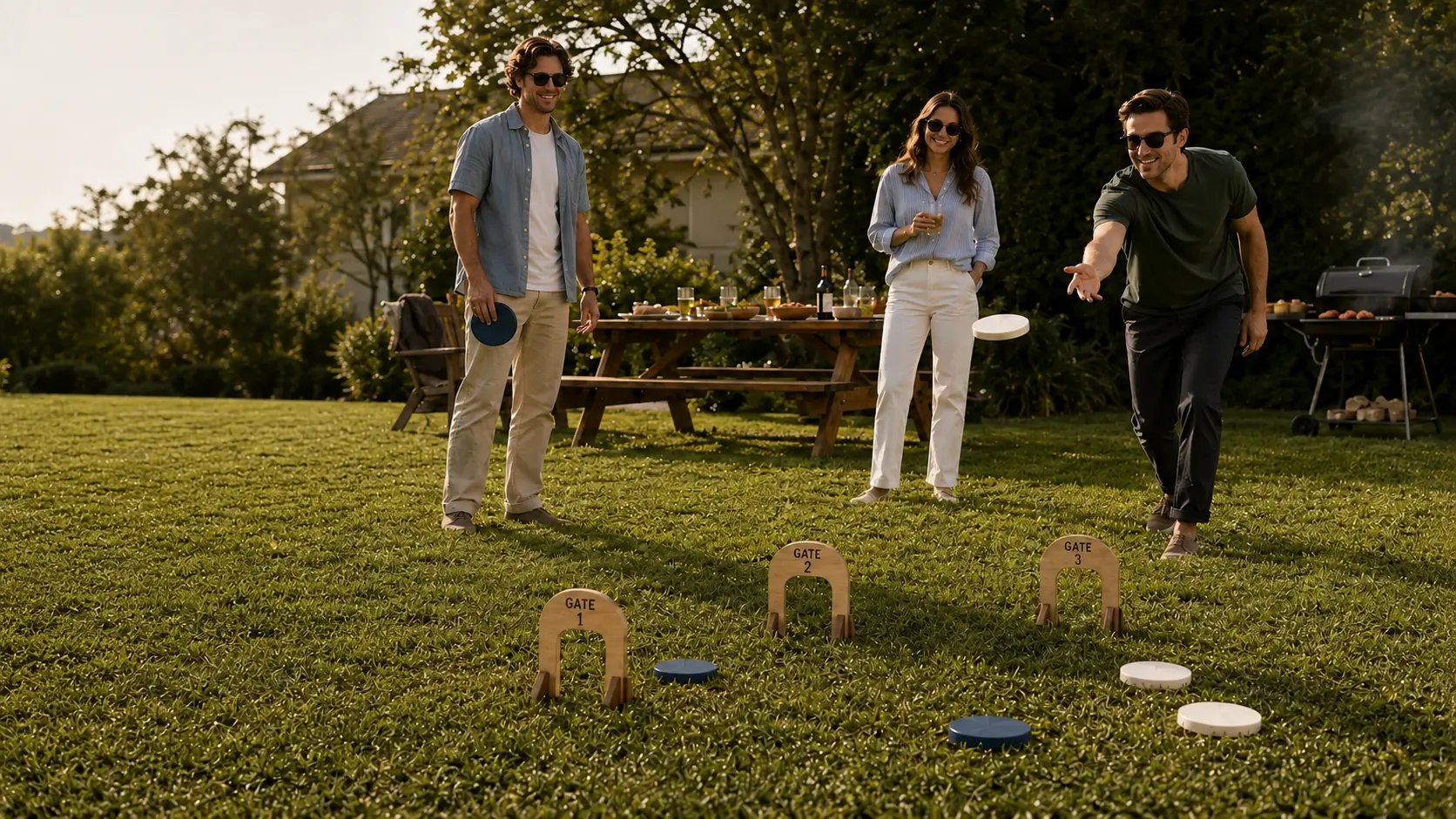
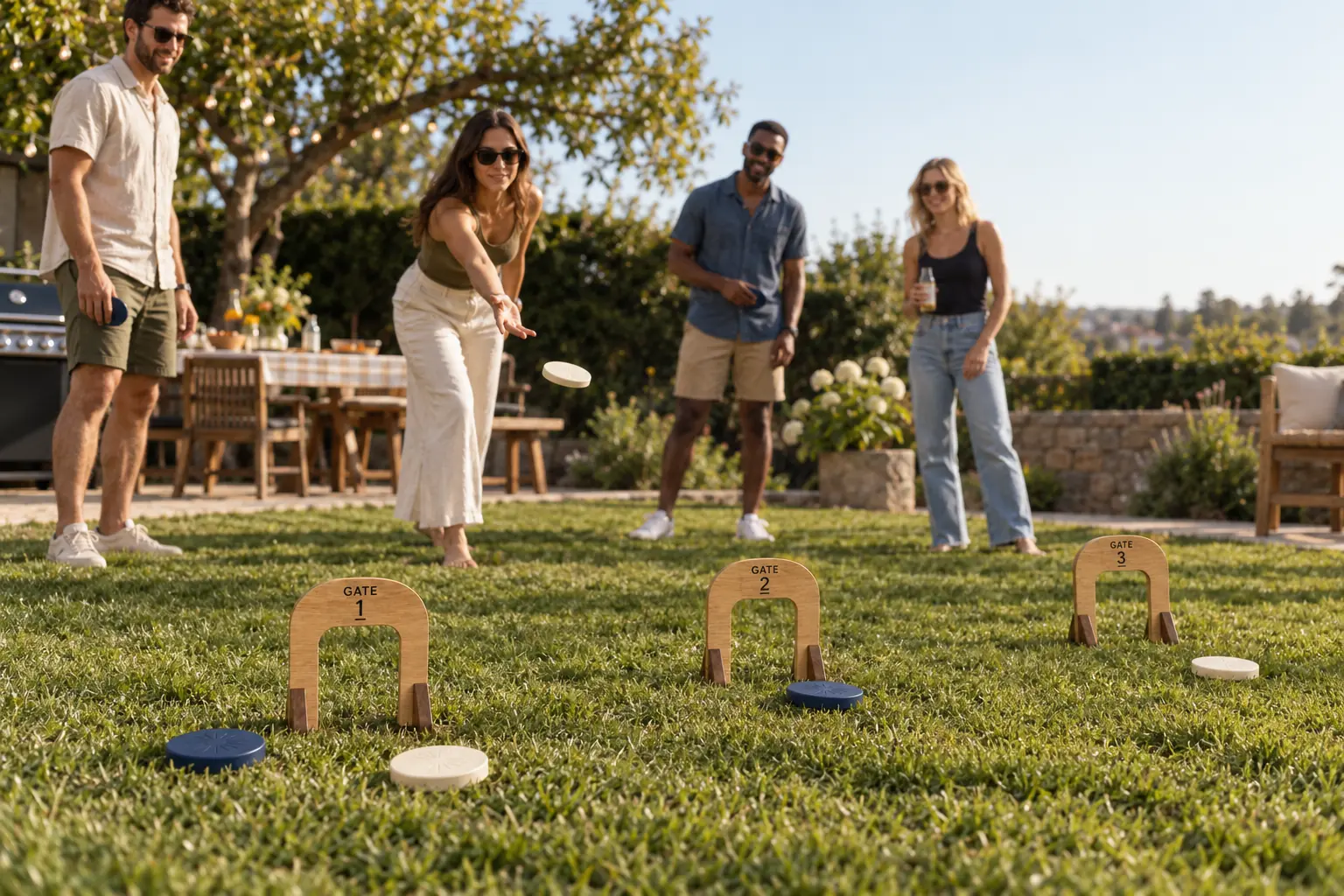
GATE is part croquet, part disc golf. Set three equal-size wooden gates, choose a route and take turns moving a puck through the course. First puck through Gate 3 wins. Trees, chairs and slopes can become part of the route, which means the same set does not have to produce the same game twice.
That flexibility is useful at a cookout: a big park can hold a wandering course, while a smaller yard can keep it direct. It takes a few minutes to place thoughtfully, so LINE is faster if setup time is truly zero. The removable feet also need ground firm enough to keep the gates upright; packed sand and grass work better than loose, collapsing sand.
07 / Best for: a strategic group with room
Kubb
Kubb is a team throwing game built around wooden blocks, batons and a central king. Teams try to knock down the opposing blocks before taking the king. The outline is approachable, but the order of play creates more strategy than the average toss-and-score lawn game.
That is the appeal for game people and the possible downside for everybody else. A proper explanation takes longer than one sentence, the field uses real yard space, and a match may outlast guests who were planning to eat in eight minutes. Put it out for a group that wants a game rather than a background activity. On those terms, it is excellent.
08 / Best for: active, competitive groups
Spikeball / roundnet
Roundnet is usually played two-on-two around a small net. A team has up to three touches to return the ball onto the net, and after the serve play can move around it. The equipment footprint is small, rallies are quick, and good plays look good enough that other people tend to watch.
The learning curve is less friendly than the equipment size suggests. Tracking the ball, moving around the net and coordinating three touches takes practice and some athletic confidence. It is one of the best outdoor games for adults who want to move, but it is not the universal answer for grandparents, little kids and someone balancing a beverage.
09 / Best for: almost no setup and very little bag
LINE
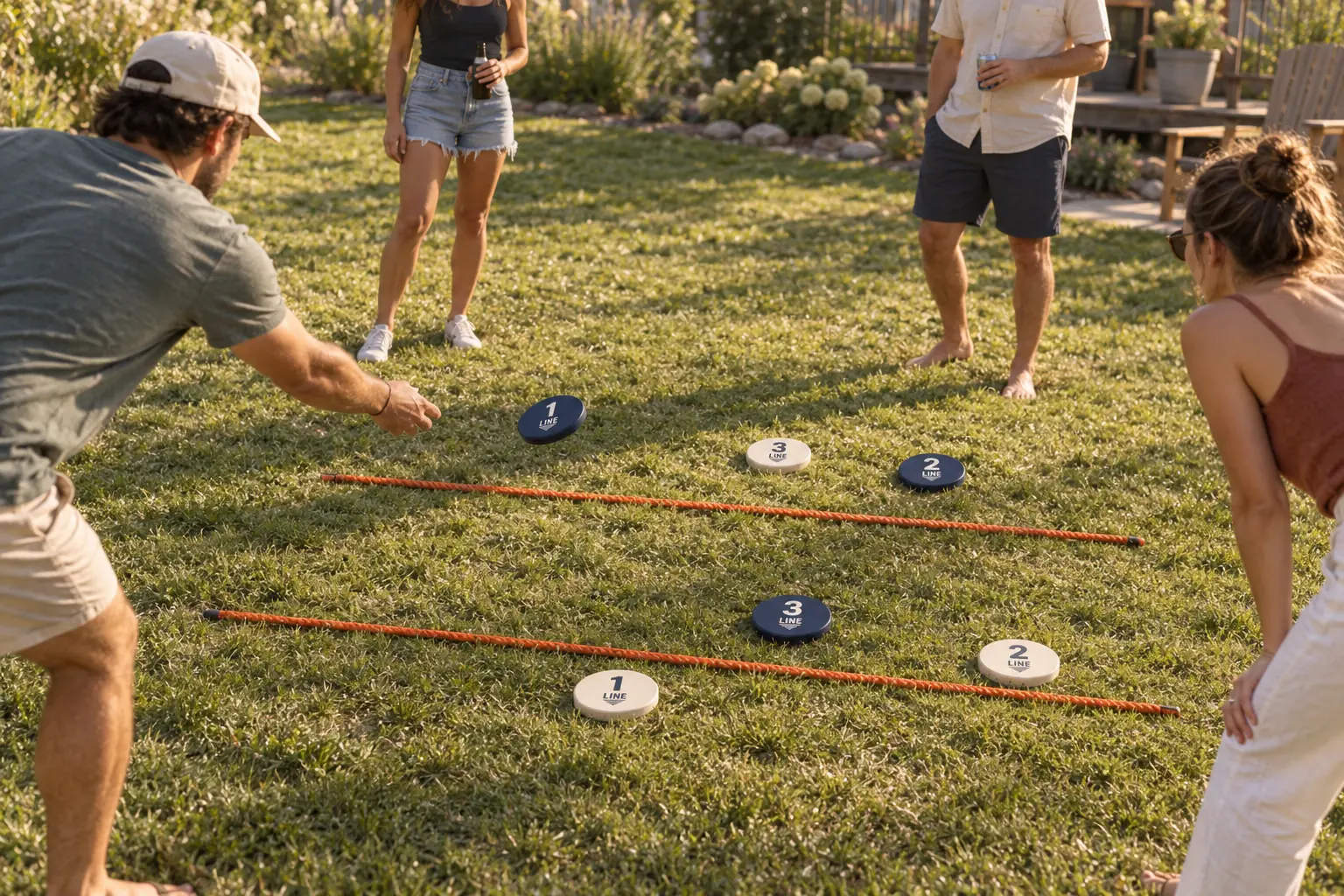
LINE uses two boundary ropes and two sets of pucks numbered 3, 2 and 1. Each player throws the 3-point puck first. If it misses the zone, they try 2, then 1, stopping when one stays in. The successful puck scores its number, and the scoring puck closest to the back line gets one extra point.
It works on grass, sand or pavement, and distances can shrink for younger players. People can understand the stakes by watching one turn, which is useful while food and conversation keep interrupting everything. The tradeoff is that it is intentionally spare. If your group wants a sprawling course or team strategy, choose something else. If you have a small space and approximately zero patience for setup, this is the point.
10 / Best for: a yard with a dedicated throwing area
Horseshoes
Horseshoes is direct, satisfying and easy to follow: pitch toward the stake, score ringers or the closest shoes, repeat. Two people or two teams of two fit naturally, and spectators can come and go without losing the plot. A permanent pit makes it feel less like setup and more like part of the yard.
Without that permanent spot, it asks more of the host. Regulation stakes sit far apart, pits take preparation and actual horseshoes are heavy metal objects being thrown through the air. Shorter casual distances help, but clear space and active supervision are not optional. Great tradition. Less ideal beside the folding kids’ table.
11 / Best for: a patio and a crowd that wants to watch
Giant Jenga
Giant Jenga requires almost no explanation. Pull one block, place it on top and avoid becoming the person who ends the tower. It works near a patio, guests can take turns between conversations, and the structure itself becomes a useful signal that there is something to do.
It is less active than most backyard games and generally supports one central game rather than play spread across the yard. The blocks also need a flat, stable base and take a minute to restack after the inevitable collapse. That said, if your cookout activities need to fit beside chairs instead of across a lawn, the small playing footprint is hard to beat.
The actual decision
So, what should you actually put out at a cookout?
Small backyard
LINE, Giant Jenga or STICKS. All three can work without reserving a regulation-sized throwing corridor.
Big backyard or park
Pair one active game—roundnet, KanJam or GATE—with a slower option such as bocce or cornhole.
Mostly hanging around
Cornhole, bocce, ladder toss and LINE make it easy to talk, watch and rotate without losing a shift.
Families with kids
Try STICKS, LINE, bocce or ladder toss. Shorten the throwing distance and keep one shared set of rules.
Approximately zero trunk space
LINE, roundnet or STICKS. Horseshoes and cornhole can stay home and think about what they have done.
People who really want a game
GATE for a configurable course, Kubb for strategy or roundnet for the group that arrived in athletic shoes.